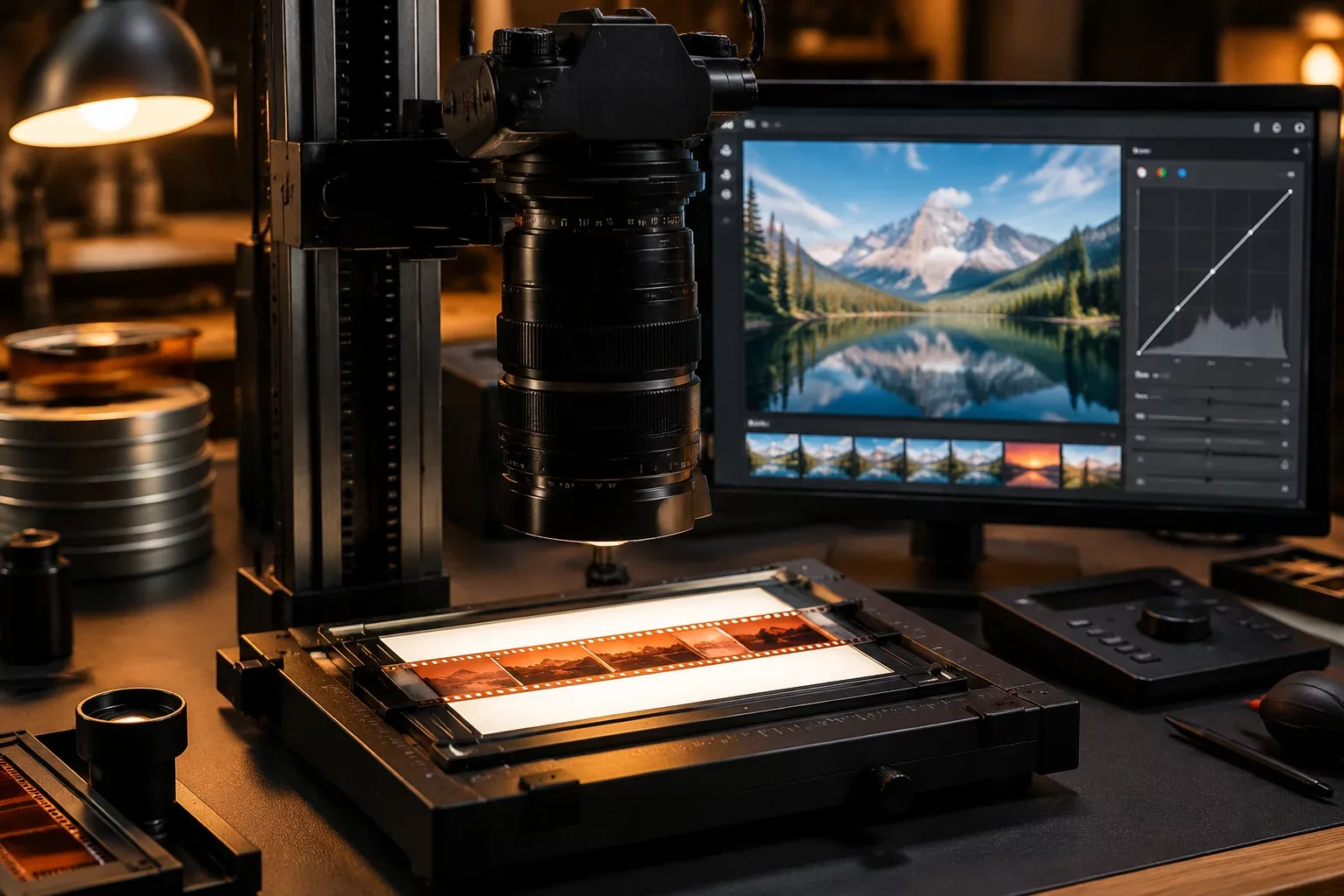
Architecture & Operational Overview
Direct negative conversion in commercial studio workflows bypasses standalone scanner utilities by leveraging tethered medium format digital backs and camera scanners. Inverting color film stocks digitally requires more than just reversing the tone curve; the dense orange cellulose acetate base introduces significant cross-channel imbalances. By establishing a rigid RAW inversion baseline inside the primary capture catalog, studio operators retain complete sensor bit-depth, streamline metadata synchronization, and eliminate third-party software bottlenecks.
Implementing this protocol requires rigorous physical and mathematical controls before the first exposure. A high-CRI light table (CRI > 98) ensures continuous spectral output across the visible spectrum, preventing discontinuous spikes that ruin shadow separation. Once the unexposed film margin provides an empirical reading of the film base, individual RGB tone channels are mapped symmetrically against custom linear response profiles, maintaining tonal roll-off in highlights while resolving deep shadow density without destructive clipping.
Request Studio Workflow Checklist
Get the complete verified routing step map, terminal naming tokens, and validation matrix.
Execution Benchmarks & Checkpoints
Operational integrity across multi-thousand frame archive digitizations relies on four non-negotiable execution benchmarks:
- Baseline Calibration & Exposure Locking: Meter through an unexposed frame rebate to position base transmission within the sensor's linear zone without clipping green and red channels.
- Spectral Mask Neutralization: Apply targeted color balance pickers directly to the clear substrate margin, establishing precise chromaticity coordinates for automated batch offset.
- Parametric Curve Inversion: Execute custom channel-by-channel level inversions using dedicated linear response curves, preserving high-density highlight detail without banding.
- Color Matrix Normalization: Reassign camera profiles to custom ICC film translation matrices, aligning dye layers (cyan, magenta, yellow) with standard D50 reproduction gamuts.
Failover & Redundancy Path
When digitizing severely degraded, expired, or non-standard emulsion formulations, automated substrate neutralization can introduce erratic color casts in skin tones. The protocol requires digital technicians to switch immediately to manual split-tone calibration: locking shadow black points to density d-min, clamping white highlights against reference d-max, and decoupling saturation compensation from midtone contrast sliders.
Direct camera-scan film conversion is only as repeatable as your substrate calibration; if the unexposed base isn't accurately neutralized in the RAW pipeline, no amount of downstream color grading can reconstruct true emulsion spectral balance.
— Amara Osei, Principal Imaging Systems Architect