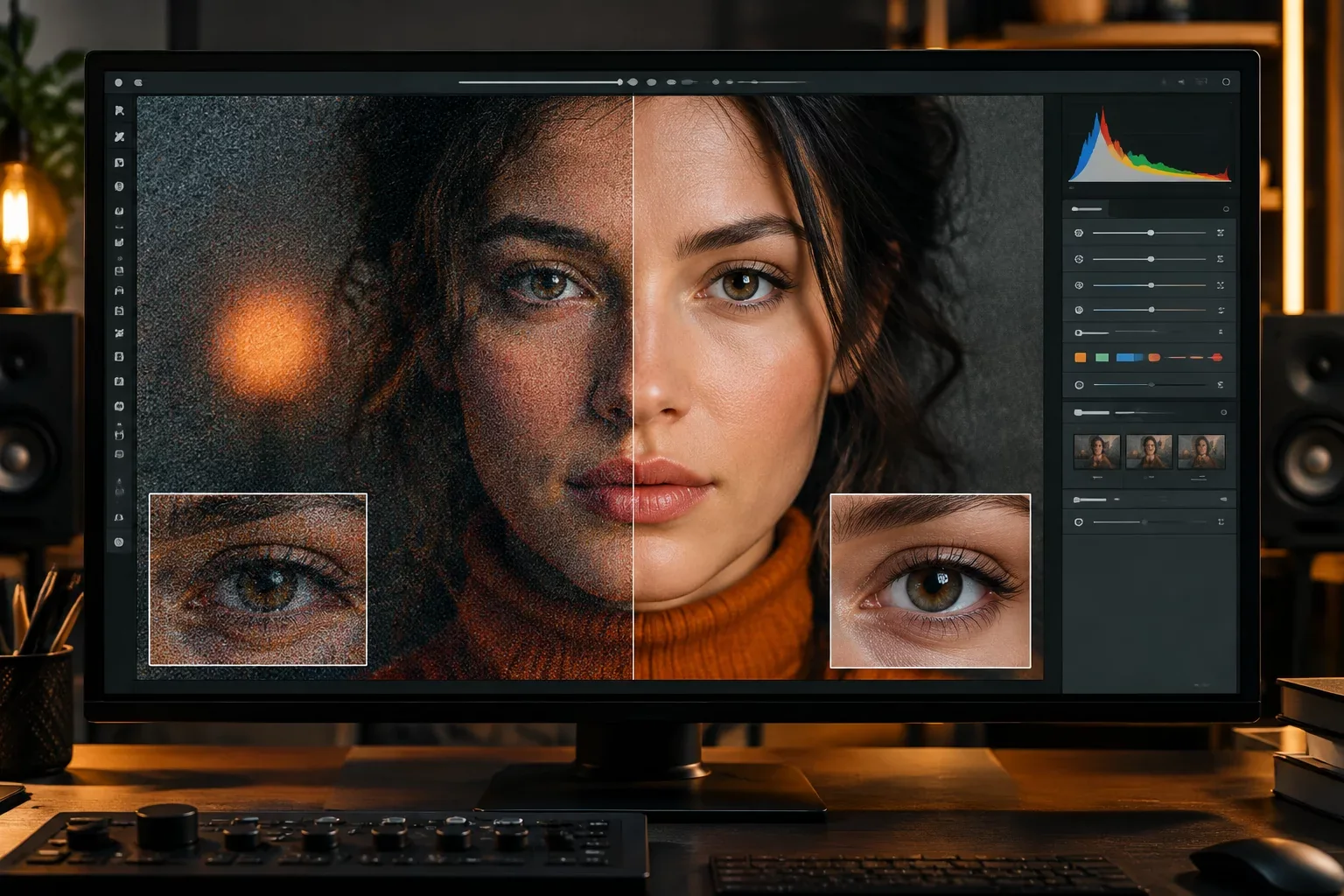
Architecture & Operational Overview
Tethered commercial sessions that operate under ambient, twilight, or high-speed sync conditions frequently force camera sensors beyond ISO 3200. Traditional noise reduction filters degrade fine fabric textures, hair strands, and reflective product edges across the primary subject. This pipeline implements a decoupled luminance-chrominance processing route, applying aggressive spatial smoothing to flat out-of-focus background planes while maintaining untouched sensor data on the subject.
The workflow initiates automatically upon tethered file ingestion into Capture One Pro or Lightroom Classic. A custom background segmentation mask identifies shadow gradients and low-frequency backdrops, routing these zones to an asynchronous neural noise evaluation module. Foreground regions retain native organic micro-grain, ensuring that retouchers and art directors evaluate authentic sharpness during live client monitor sessions without perceptible system lag.
Request Studio Workflow Checklist
Get the complete verified routing step map, terminal naming tokens, and validation matrix.
Execution Benchmarks & Checkpoints
Digital technicians must implement strict verification benchmarks at designated points during tethered operations to prevent pipeline bottlenecks and ensure color profile consistency across all batch exports:
- Verify that dual GPU allocation distributes segmentation inference to the secondary compute card, preventing UI frame drops on primary client displays.
- Calibrate chrominance noise suppression sliders between 38% and 44% to eliminate color mottling in dark backdrop corners without washing out deep textile hues.
- Check edge contrast feathering boundaries at 100% zoom to confirm transition borders around subject silhouettes do not exhibit dark halos or bleeding artifacts.
- Confirm sidecar EIP or XMP metadata packages embed the selective suppression recipe prior to downstream server synchronization.
Failover & Redundancy Path
When high burst frame rates saturate GPU memory buffers or unexpected software crashes interrupt background computation, the ingest daemon bypasses neural segmentation. The pipeline immediately routes incoming frames to a fallback bilateral luminance filter applied globally at 18%, preserving capture speed and preventing live shoot interruptions. Retouching stations re-apply the enhanced regional pipeline asynchronously once primary tethered shooting pauses for wardrobe or lighting changes.
Selective background noise reduction preserves the tactile reality of the subject while delivering the pristine studio backdrop that commercial clients expect from premium production environments.
— Sarah Jenkins, Digital Workflow Architect