Architecture & Operational Overview
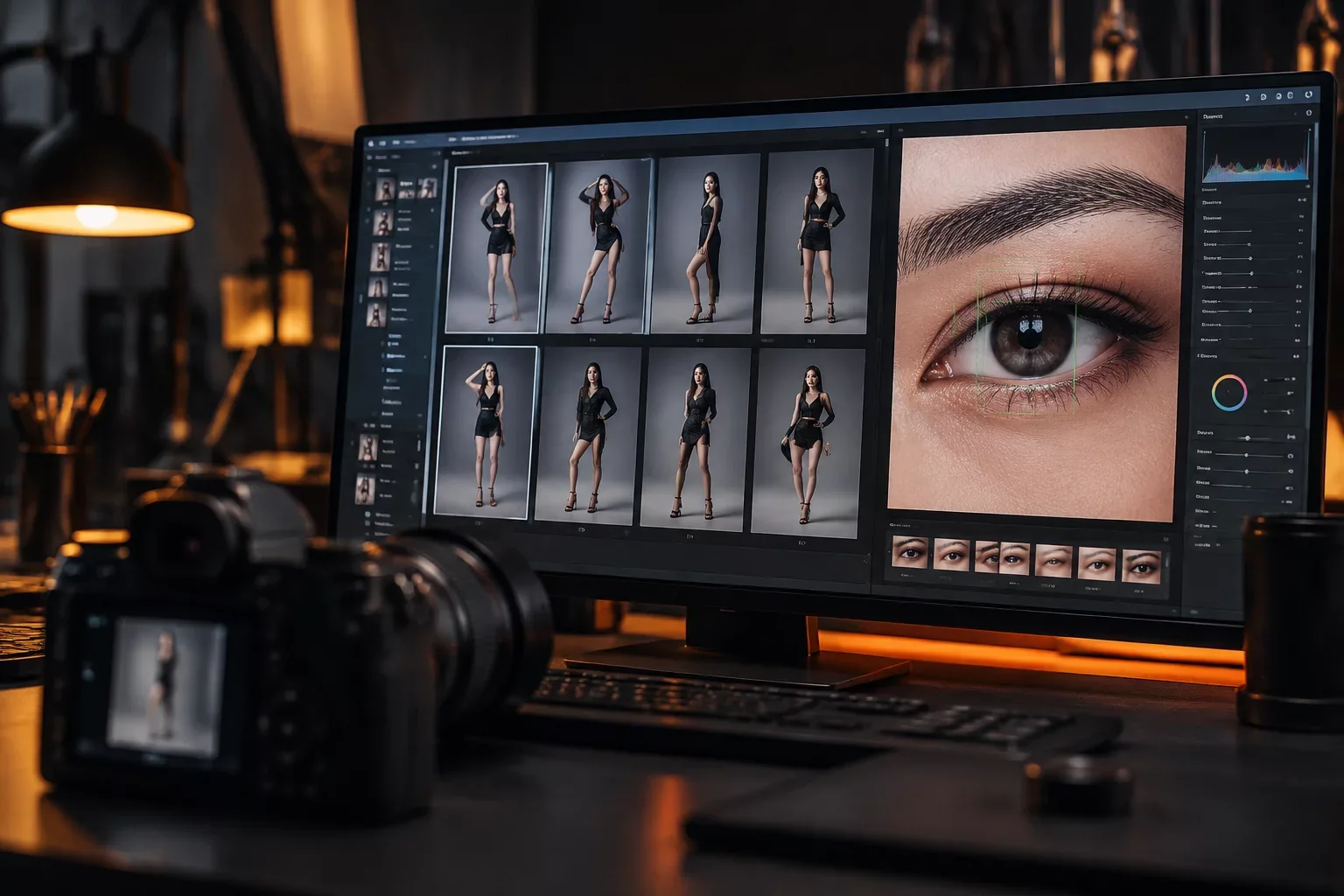
High-volume commercial sessions demand immediate clarity on whether the critical subject plane meets razor-sharp tolerances before lighting transitions or wardrobe changes take place. Assisted review utilizes lightweight local neural inference engines to inspect incoming RAW frames right after ingestion, calculating high-frequency gradient density across targeted anatomical landmarks without human lag.
Rather than forcing the digital tech to manually punch in to 100 percent zoom across every burst, the system maps facial bounding coordinates and isolates the nearest iris. An acutance score is then computed against baseline calibration standards, appending a temporary color tag or metadata flag directly into the session database. This real-time filtering enables the crew to identify soft captures immediately, preventing costly reshoots while keeping the tethered queue moving smoothly.
Request Studio Workflow Checklist
Get the complete verified routing step map, terminal naming tokens, and validation matrix.
Execution Benchmarks & Checkpoints
Ensuring operational stability on set requires adhering to clear verification criteria across each tethered burst. The following automated checkpoints execute automatically as assets pass from the primary tether cache to client review monitors:
- Automatic detection of subject ocular landmarks within 180 milliseconds of full-resolution RAW preview generation.
- Edge gradient contrast calculation against reference MTF curves calibrated for modern high-resolution sensor matrices.
- Real-time assignment of amber cautionary ratings whenever fine eyelash detail drops below 78 percent of established focus thresholds.
- Synchronous communication with secondary display stations to float dynamic 200 percent focus inspection loupes over the primary eyes.
Failover & Redundancy Path
Whenever extreme studio lighting conditions, heavy foreground elements, or unusual profile angles confuse automated detection vectors, the review pipe gracefully falls back to mechanical cursor anchor inspection. The software preserves incoming tether speed without blocking system memory, ensuring zero dropped frames across continuous shooting runs.
Automated verification is not about replacing the digital tech's eye; it is about providing instant mathematical confirmation so the creative crew never leaves a setup wondering if the money shot was critically sharp.
— Studio Operations Technical Directorate