Architecture & Operational Overview
At the conclusion of a high-tempo commercial photoshoot, asset integrity depends entirely on the discipline of wrap-stage packaging. The delivery phase is not merely copying folders to an external solid-state drive; it is a structured transition that turns a volatile live production directory into an immutable, fully verified historical archive.
The packaging route begins the moment the photographer calls wrap on the final setup. All temporary render caches, transient scratch files, and incomplete proxy batches are purged from the working tree. Session metadata is committed into embedded sidecars or closed into self-contained EIP bundles. Three synchronized destinations receive write-protected copies simultaneously over verified NVMe storage channels, ensuring that no client leaves the sound stage without authenticated physical media and cryptographic receipt logs.
Request Studio Workflow Checklist
Get the complete verified routing step map, terminal naming tokens, and validation matrix.
Execution Benchmarks & Checkpoints
Execute the wrap packaging procedure in strict sequence. Each checkpoint guarantees mathematical parity before physical drives are disconnected from the primary digital technician workstation.
- Verify session database closure by dismounting local capture engines, ensuring all in-flight RAW adjustment cosmologies and color balance matrices are fully committed to drive sectors.
- Execute terminal-driven SHA-256 hash tree generation across the master captures folder, logging every original raw frame and cropped preview variant to a plain text manifest.
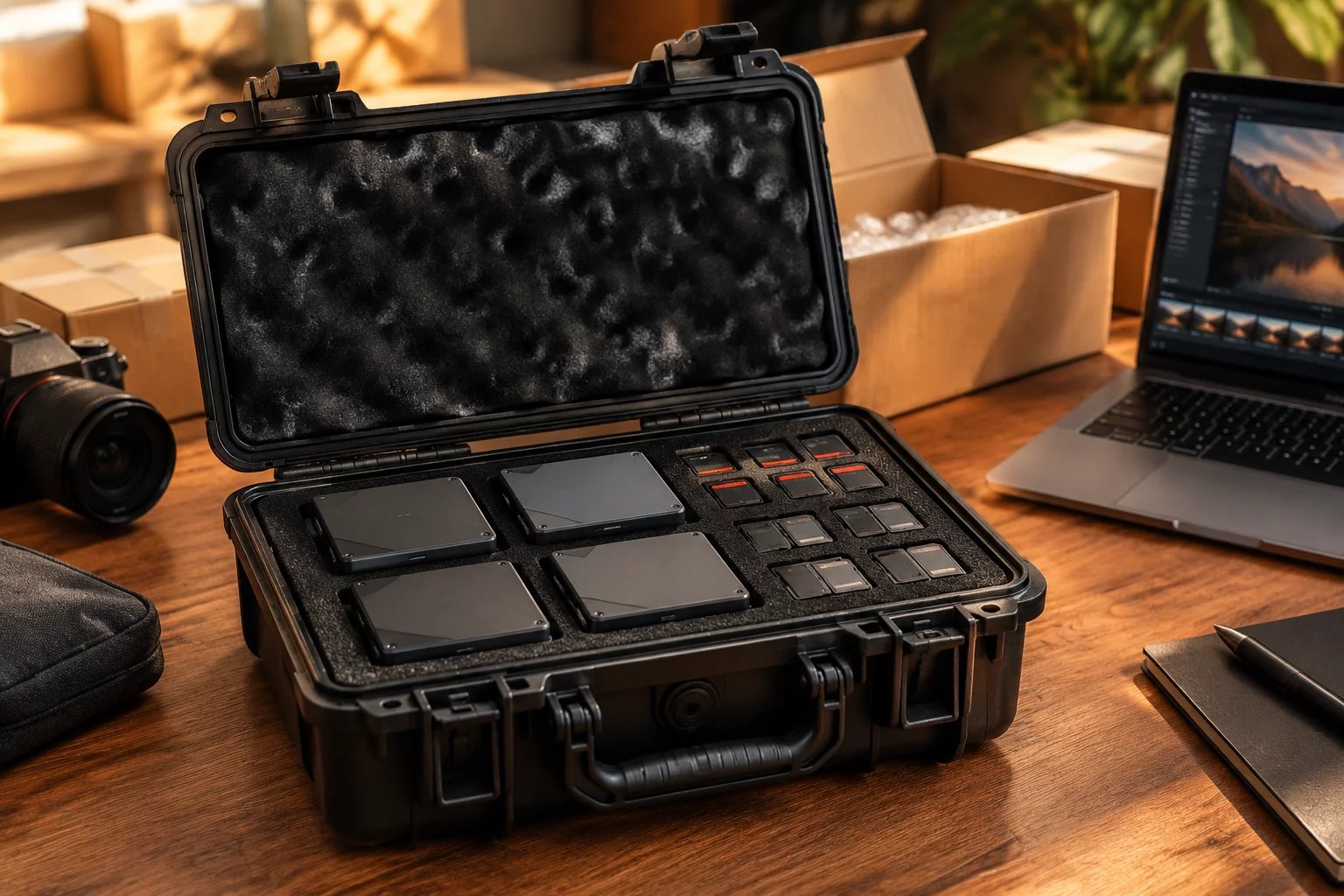
- Mirror the complete folder taxonomy across Drive A (Primary Client Delivery), Drive B (Studio Offline Vault), and Drive C (Lead Tech Safety Mirror) via block-level verification utilities.
- Complete a signed physical custody manifest confirming total capture count, approved selects volume, output asset counts, and storage hardware serial identifiers before releasing drives to the production supervisor.
Failover & Redundancy Path
When high-speed Thunderbolt buses experience thermal throttling during multi-hundred-gigabyte copy jobs or when checksum mismatches flag corrupted sectors on destination solid-state drives, immediate failover protocols take over. Write streams drop to dedicated secondary NVMe enclosures, and damaged targets are isolated without halting the main verification pipeline. A checksum mismatch instantly triggers sector inspection rather than an unverified re-copy attempt.
"A commercial shoot is never finished when the camera stops clicking; it is concluded only when two matching drives produce identical checksum logs and the client signs the custody receipt."
— Standard Studio Protocol Manual, Section 08.4